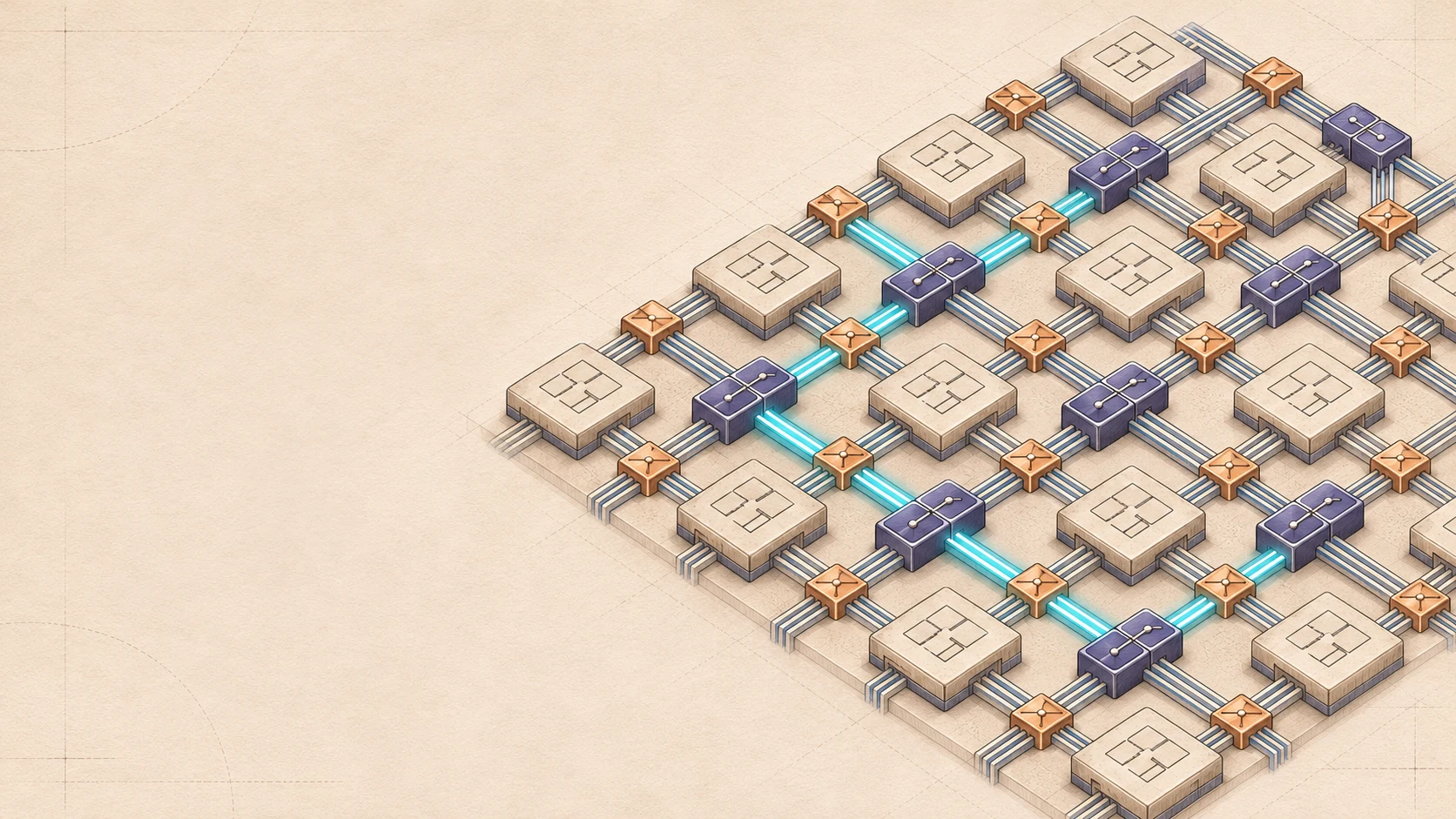
Isometric FPGA fabric with copper and indigo switch families assigned across logic tiles and routing channels
← Recent publications

Featured work · ICCAD 2026

SHiFT

Let each FPGA block choose the switch its technology needs.

SHiFT jointly optimizes switch type and transistor sizing across logic and routing blocks, connecting device-level trade-offs to the frequency–area choices available to real FPGA workloads.

Authors

Navya Agarwal · Moritz Brunion · Dawit Abdi · Chang Gao · Siva Satyendra Sahoo

Publication avenue

IEEE/ACM International Conference on Computer-Aided Design · ICCAD 2026

Event

Presented 9 November 2026 · San Jose, California, USA
01

The homogeneous assumption

Why this work

One switch style no longer fits every FPGA block—or every node.

Programmable selection appears throughout an FPGA: inside look-up tables (LUTs), in local routing, and at the connections between routing channels. At gate-all-around (GAA) and complementary FET (CFET) nodes, the area–delay balance between pass-transistor (PT) and transmission-gate (TG) selectors changes with both the block’s role and transistor sizing.

Conventional fabric

A uniform switch decision.

An all-PT or all-TG baseline applies one selector family across the fabric. This limits the search even when the logic and routing blocks would benefit from different electrical choices.

Advanced nodes

Device physics shifts by context.

GAA and CFET parasitics, sizing, and stacking alter the relative delay and area of PT and TG implementations differently in logic and routing blocks.

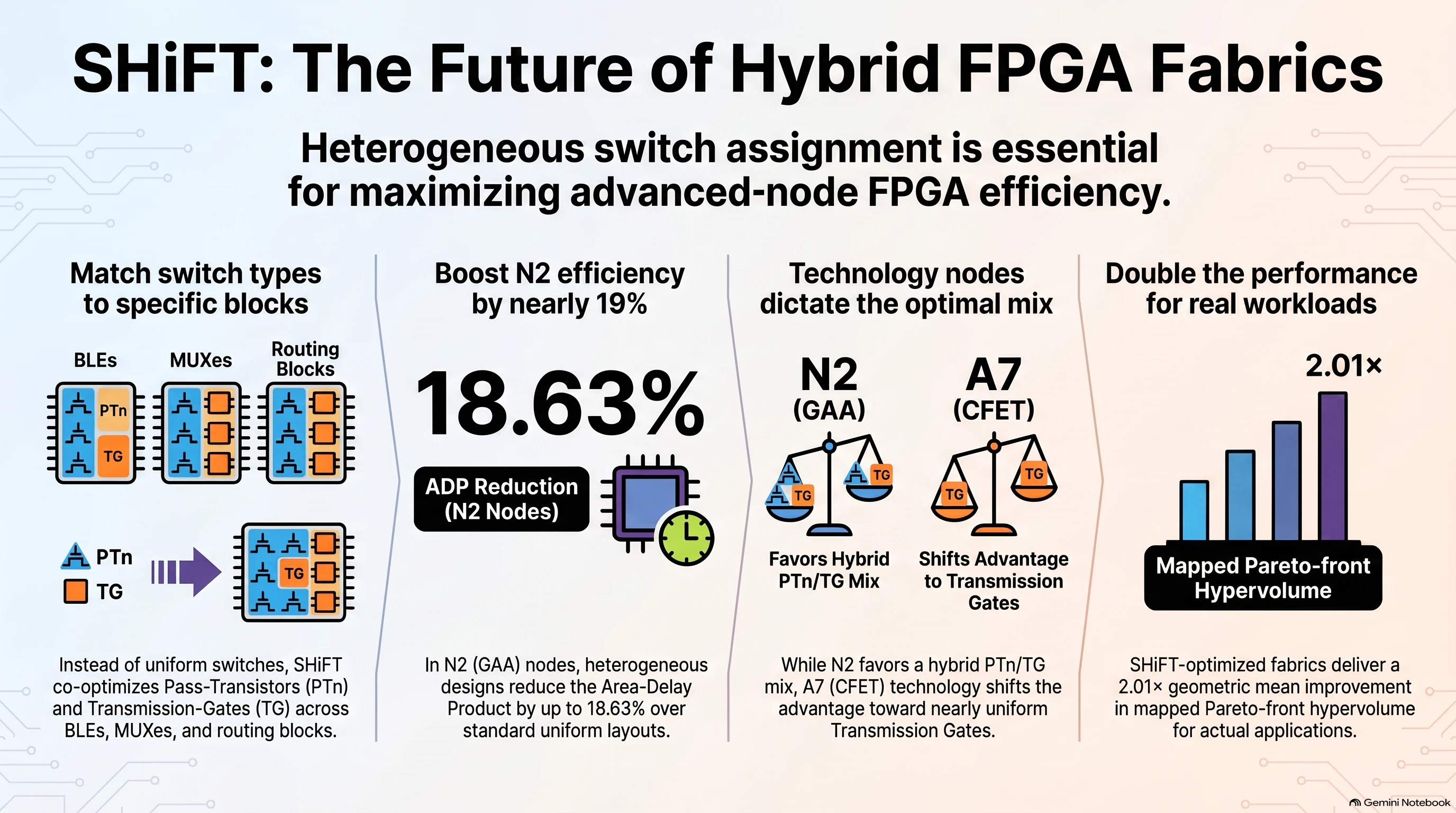
SHiFT infographic relating block-specific switch assignment, N2 area–delay improvements, A7 node behavior, and mapped Pareto-front hypervolume
The advantage depends on the node: N2 supports a useful PT/TG mix, while A7 moves toward uniform TG. The 2.01× result measures mapped Pareto-front hypervolume rather than a direct application-speed increase.
MAP

Concept relationships

From device behavior to mapped fabrics

Connect the technology, the switch, and the architectural decision.

Device models establish the available trade-offs. Block-level switch assignments and transistor sizing determine which fabrics can be built; placement and routing reveal which benefits survive workload mapping.

SHiFT
Node scenariosBulk 22 nm and FinFET references; GAA N2 and CFET A7 focus
PT and TG selectorsCompare area and delay under consistent conditions
Compact modelsEfficient sizing and broad candidate exploration
Extracted parasiticsSwitch-parasitic extraction refines promising candidates
02

The approach

Circuit-to-architecture co-optimization

Promote switch assignment to a first-class CAD variable.

Choosing a fast selector in isolation does not guarantee a better FPGA. SHiFT links characterization, joint assignment and sizing, and workload mapping so that a candidate is judged by the complete fabric it produces. Each technology node is evaluated separately under consistent conditions.

01 / Characterize

Resolve the device trade-off.

Size pass-transistor (PT) and transmission-gate (TG) selectors under the same technology and electrical conditions.

  • Node-specific device models
  • Connected driver and sink loads
  • Compact models and extracted parasitics
Output: block area and delay
02 / Co-optimize

Search assignments and sizes together.

Choose PT or TG independently for each block class, then tune the transistor sizes for the resulting fabric.

  • BLE / LUT-related logic
  • Local routing multiplexers
  • Connection and switch blocks
Output: candidate fabric frontier
03 / Map workloads

Test the architectural consequence.

Place and route benchmark circuits with VPR to measure whether circuit-level choices improve the mapped design space.

  • Consistent homogeneous baselines
  • Frequency and area trade-offs
  • Pareto-front hypervolume
Output: workload-level evidence

Two levels of fidelity. Compact models explore broadly; selective switch-parasitic extraction refines promising candidates before workload evaluation.

03

Inside the fabric

Node-dependent architecture

Heterogeneity is valuable only while the physics preserves a trade-off.

Switch family

Choose the electrical implementation

Pass transistors and transmission gates implement the same selection function with different circuit structures and area–delay behavior.

Architectural role

Account for where the selector sits

LUT-related logic, local multiplexers, connection blocks, and switch blocks have different loads and contributions to the fabric’s total area and delay.

Transistor sizing

Tune the selected combination

A switch replacement changes the electrical context. Joint sizing allows the heterogeneous candidate to find its own trade-off instead of inheriting a homogeneous design’s dimensions.

Four block classes · independent switch choices

Heterogeneity changes the selector family within one technology node. The assignment is optimized jointly with sizing.

BLE / LUT

Logic selection

Selectors inside the basic logic element and look-up table.

PTorTG
LM

Local routing

Multiplexers that connect signals within the logic cluster.

PTorTG
CB

Connection block

Selectors linking logic pins to the surrounding routing channels.

PTorTG
SB

Switch block

Programmable connections between routing channels.

PTorTG

N2 · gate-all-around

The area–speed tension remains.

TG selectors offer lower delay, while PT selectors retain an area advantage in useful block contexts. Mixed assignments can improve on both uniform baselines.

Optimize the mix

A7 · complementary FET

The TG area penalty contracts.

With little or no area penalty left to offset the delay advantage, the preferred assignment moves toward a nearly uniform TG fabric.

Re-evaluate the mix at each node
04

Measured impact

What changed

The optimized fabric follows the technology node—not a fixed rule.

The study evaluates circuit-level area–delay product (ADP) and the mapped frequency–area Pareto frontier separately. N2 retains an exploitable heterogeneous design space; in A7, the preferred assignment approaches uniform TG as its area penalty diminishes.

N2 circuit-level comparison

Lower area–delay product against both homogeneous baselines.

Versus all-PT17.27% lowerGeometric mean · 14.68–18.63% across evaluated architectures
Versus all-TG11.20% lowerGeometric mean · 10.45–11.62% across evaluated architectures

After placement and routing

2.01×

Geometric-mean Pareto-front hypervolume improvement

Across 24 default-weight workload–architecture cases, with improvements from 1.28× to 4.06× and a median of 1.90×.

Hypervolume measures the quality of the frequency–area trade-off set; it is not a direct multiplier of application speed.

05

Details

Technology, architecture, and evaluation

From device scaling to workload-mapped FPGA fabrics.

The N2 and A7 comparisons trace how selector physics changes the architectural optimum, from circuit sizing and block assignments to mapped workload trade-offs.
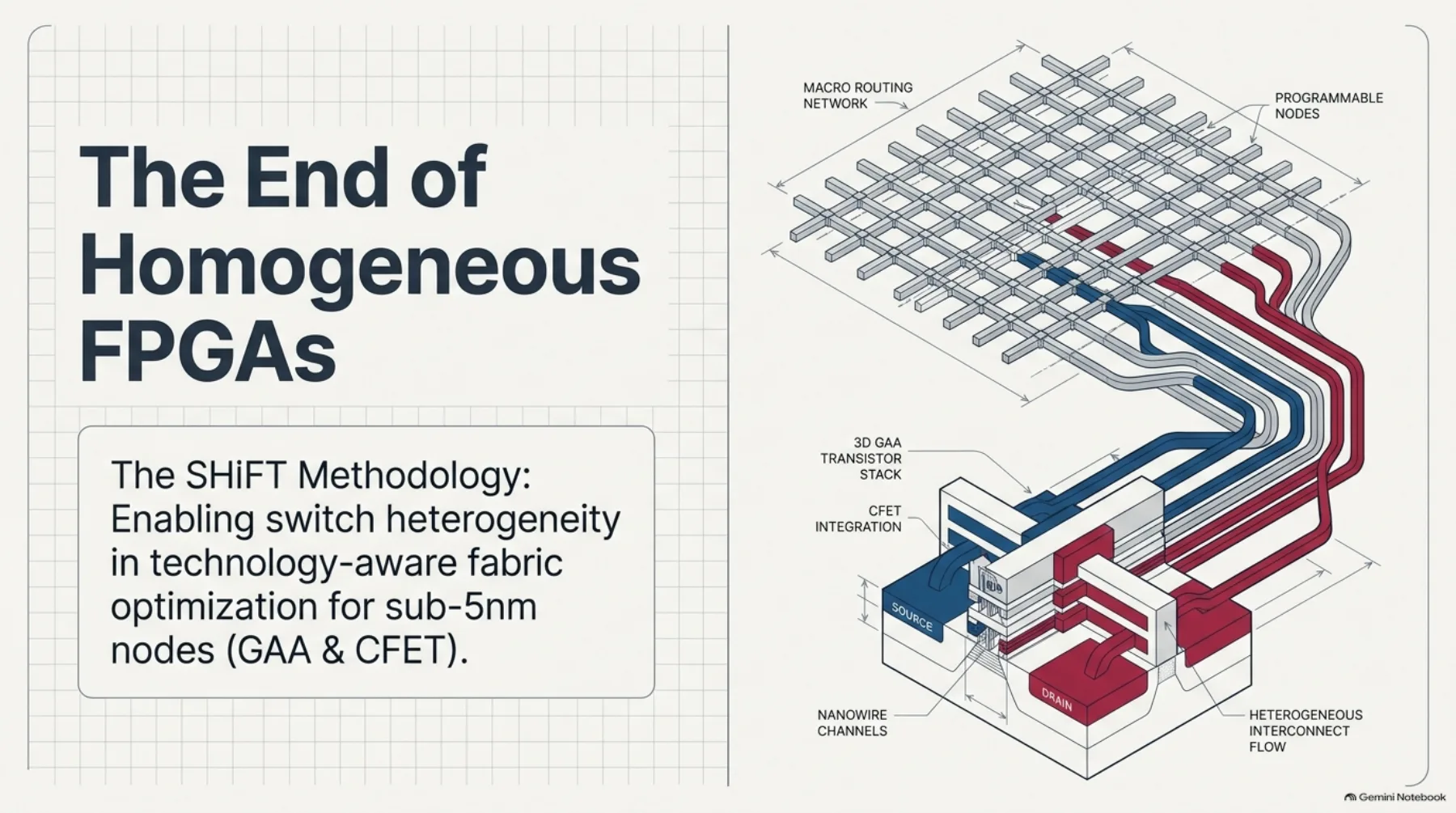
Presentation slide 1: The end of homogeneous FPGAs

01The end of homogeneous FPGAs

06

Watch

Switch choices and architectural consequences

Follow the circuit-to-fabric argument in brief or in depth.

Quick overview

SHiFT in brief

Why advanced nodes break the homogeneous-switch assumption and what the expanded design space reveals.

Detailed presentation

Technology-aware FPGA fabric optimization

Follow the device models, PT/TG co-optimization, N2/A7 regimes, and workload-mapped evaluation.

07

Publication

ICCAD 2026 · Presented 9 November

SHiFT: switch heterogeneity as an FPGA design variable.
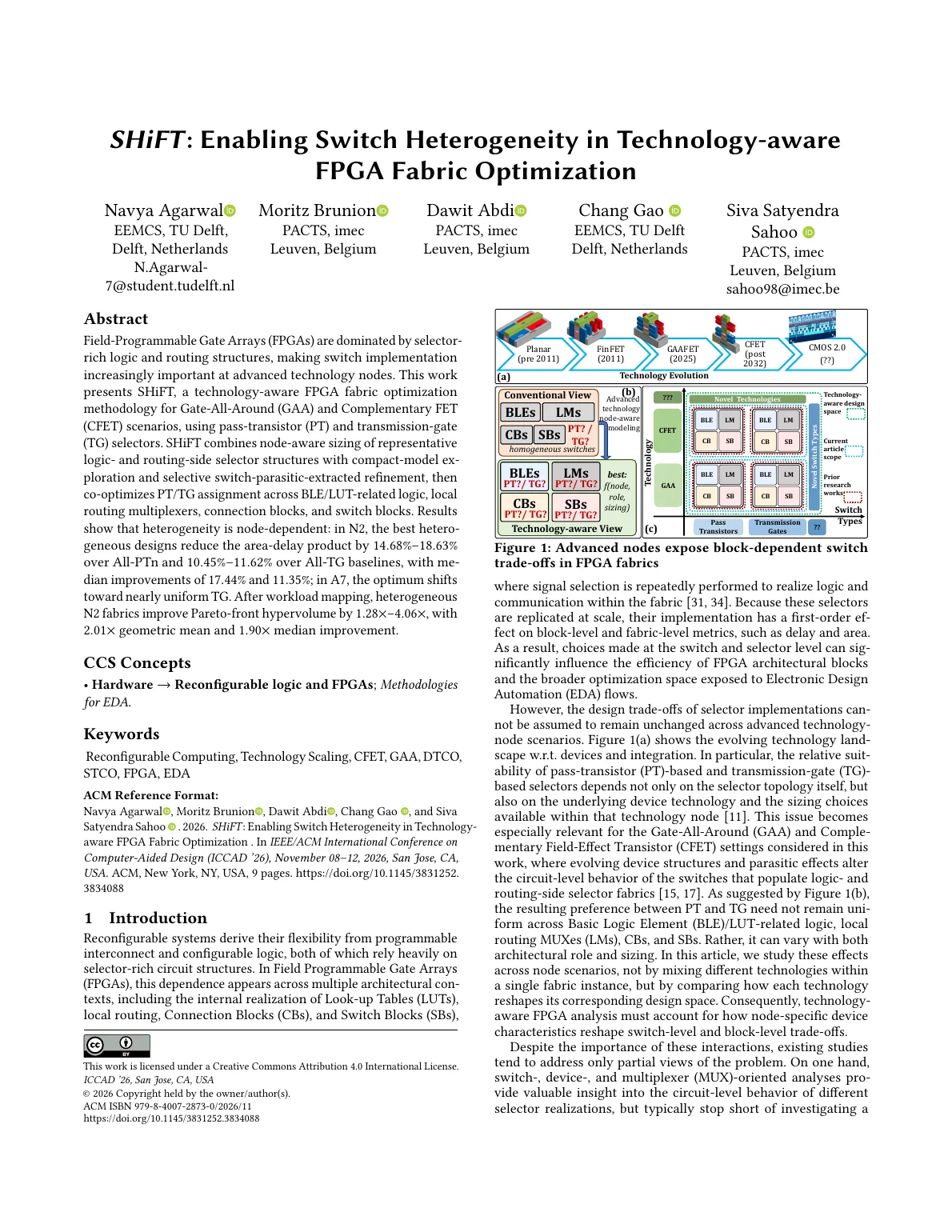
First page of the published SHiFT articleOpen published article ↗

Navya Agarwal, Moritz Brunion, Dawit Abdi, Chang Gao, and Siva Satyendra Sahoo. “SHiFT: Enabling Switch Heterogeneity in Technology-aware FPGA Fabric Optimization.” In the proceedings of the IEEE/ACM International Conference on Computer-Aided Design (ICCAD ’26), San Jose, California, USA, 8–12 November 2026.

DOI · 10.1145/3831252.3834088

01

Navya Agarwal

Electrical Engineering, Mathematics and Computer Science

TU Delft · Delft, Netherlands

02

Moritz Brunion

Pathfinding Co-optimization Technology & Systems

imec · Leuven, Belgium

03

Dawit Abdi

Pathfinding Co-optimization Technology & Systems

imec · Leuven, Belgium

04

Chang Gao

Electrical Engineering, Mathematics and Computer Science

TU Delft · Delft, Netherlands

05

Siva Satyendra Sahoo

Pathfinding Co-optimization Technology & Systems

imec · Leuven, Belgium

Continue exploring the research landscape

Technology-aware Design →