
Featured work · CASES / IEEE TCAD 2026
AxO-ReQ
Approximation as an engine for reliable edge AI.
A representation-and-operator co-design that protects the most significant fields of quantized weights, detects inconsistencies inside the multiplier, and improves fault resilience without widening the standard 8-bit format.
Authors
Salim Ullah · Siva Satyendra Sahoo · Akash Kumar
Publication avenue
IEEE Transactions on Computer-Aided Design of Integrated Circuits and Systems
Event
Presented at CASES · Embedded Systems Week 2026
The fault-tolerance paradox
Why this work
Edge AI needs reliability, but conventional redundancy spends too much to provide it.
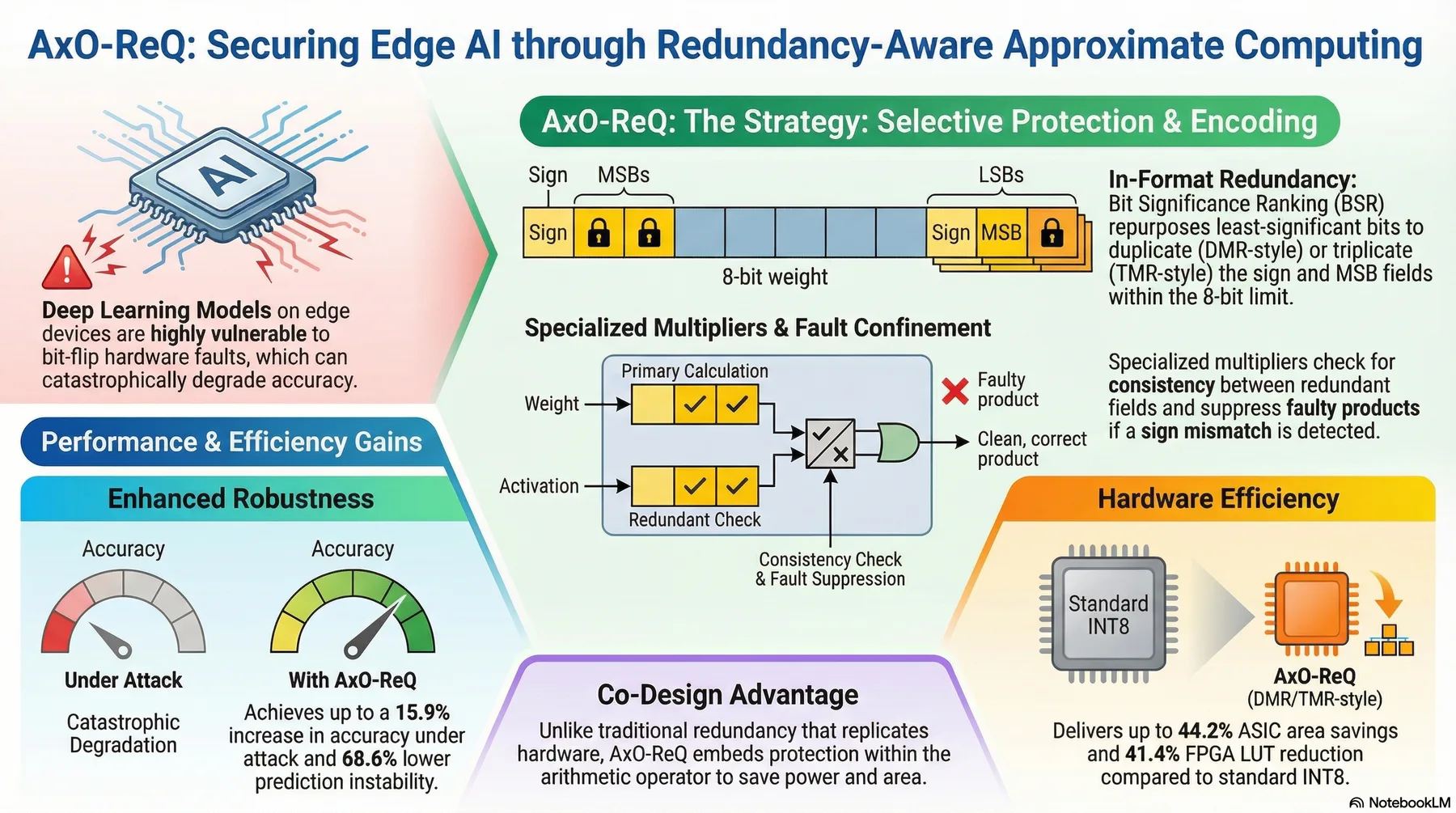
Quantization and approximate arithmetic make neural inference practical on resource-constrained devices, yet transient and malicious bit flips can destabilize their outputs. Conventional DMR, TMR, and error-correcting codes restore robustness by adding replicated logic or storage—the resources edge systems are trying to save.
Efficient, but exposed to faults.
Reduced precision lowers compute and memory cost, while faults in a sign or upper-magnitude bit can still produce a disproportionately large change in the inferred result.
Robust, but wider and heavier.
Typical DMR/TMR and SECDED add storage bits, replicated arithmetic, comparison, or voting logic—turning reliability into a substantial hardware and energy tax.

Concept relationships
From vulnerability to implementation
Four connected ideas define the AxO-ReQ co-design.
Bit-significance analysis determines what to protect; fixed-width encoding determines where that protection resides; the multiplier determines how disagreement is contained; and evaluation measures the resulting accuracy, stability, and hardware cost.
The approach
Representation–operator co-design
Embed protection into the data—and teach the arithmetic to use it.
Two fixed-width encodings duplicate selected sign and upper-magnitude information or triplicate the sign. A co-designed approximate multiplier interprets those redundant fields during computation, detects inconsistency, and suppresses or confines a corrupted contribution before it propagates through the network.
One word · three interpretations
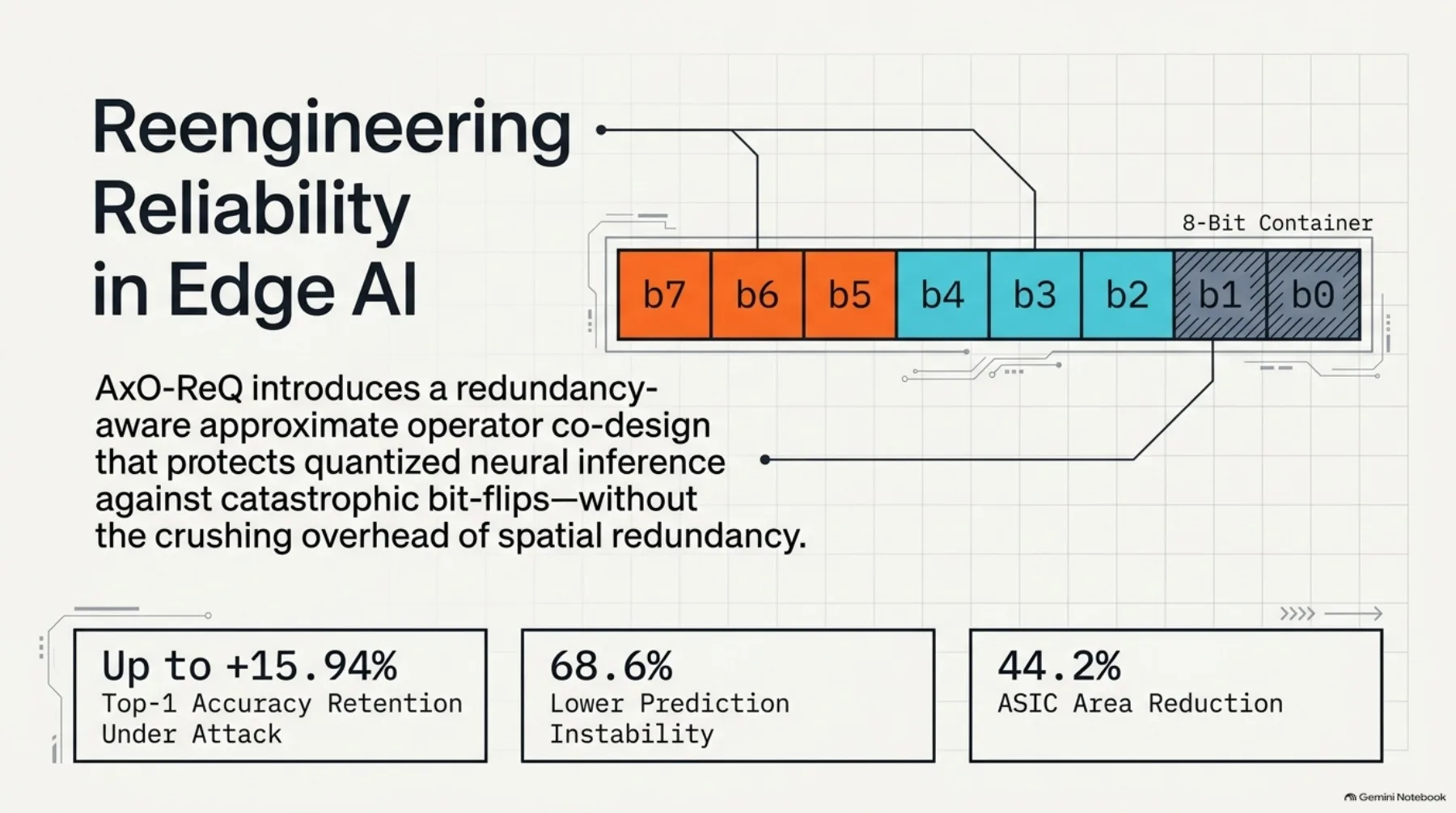
The storage width remains constant. Only the allocation of its eight positions changes.
Full precision, no embedded protection.
Protect the sign and b6 through paired consistency checks.
Protect the sign with majority voting while preserving upper magnitude.
Inside the operator
In-flight fault containment
The multiplier becomes both compute engine and local reliability mechanism.
Encoding
Protect unequal bit significance
Product-space bit-significance ranking identifies sign and upper-magnitude fields as the most vulnerable, focusing a fixed redundancy budget where a flip matters most.
Checking
Detect inconsistency before multiplication
DMR-like and TMR-style encodings expose disagreement in the protected fields, allowing the operator to choose nominal computation, attenuation, or suppression.
Co-design
Fine-tune for the protected format
Offline and hybrid encoding workflows adapt network parameters to the co-designed reduced-precision representation before fault evaluation.
Encoded weight
Protected fields + retained magnitudeOne fixed-width operand enters the operator.No → suppress the product. Yes → test m0 against m1; clear the protected magnitude field when they disagree.
Recover the effective sign from the three copies, masking any single sign-bit upset.
Reduced-significance arithmetic
6 × 6Multiply the reconstructed weight and truncated activation, then restore fixed-point scale.Measured impact
Robustness within the eight-bit budget
Selective protection improves both inference behavior and implementation efficiency.
The evaluation spans VGG-13 and ResNet-18 on CIFAR-10 and CIFAR-100 under Rowhammer-style, random, single-event-upset, and multi-bit-upset faults. The strongest DMR- or TMR-style encoding depends on the fault pattern, but both retain the original 8-bit storage width.
Attacked inference
+15.94 ppTop-1 accuracy over standard INT8
The largest reported gain occurs for VGG-13 under severe Rowhammer-like bit flips.
Output behavior
Fewer label disagreements and smaller shifts in the predicted output distribution.
Implementation
Reduced-significance arithmetic lowers cost relative to the accurate multiplier baseline.
Details
Encoding, containment, and evaluation
Bit significance determines both protection and arithmetic behavior.
Product-space sensitivity exposes the sign and upper-magnitude fields as the dominant fault contributors. AxO-ReQ reallocates two low-significance positions, resolves the resulting redundant fields inside the multiplier, and tests the co-design across multiple networks, datasets, and fault models.
01Reengineering reliability in edge AI
Watch
Encoding and multiplier walkthroughs
See how fixed-width redundancy becomes local fault containment.
Quick overview
AxO-ReQ in brief
How fixed-width encoding and smart arithmetic protect quantized neural inference without full redundancy.
Detailed presentation
Reliable approximate neural acceleration
Bit-sensitivity analysis motivates two encodings whose redundant fields are interpreted by the approximate multiplier during inference.
Publication
IEEE TCAD · CASES / ESWEEK 2026
AxO-ReQ joins reliable encoding with approximate arithmetic.
Salim Ullah, Siva Satyendra Sahoo, and Akash Kumar. “AxO-ReQ: Redundancy-Aware Approximate Multipliers for Reliable Quantized Neural Acceleration.” Accepted in IEEE Transactions on Computer-Aided Design of Integrated Circuits and Systems and presented at CASES, Embedded Systems Week 2026.
Presented · CASES / ESWEEK 2026 · IEEE TCAD
Salim Ullah
Chair of Embedded Systems
Ruhr University Bochum · Bochum, Germany
Siva Satyendra Sahoo
Pathfinding Co-optimization Technology & Systems
imec · Leuven, Belgium
Akash Kumar
Chair of Embedded Systems
Ruhr University Bochum · Bochum, Germany
